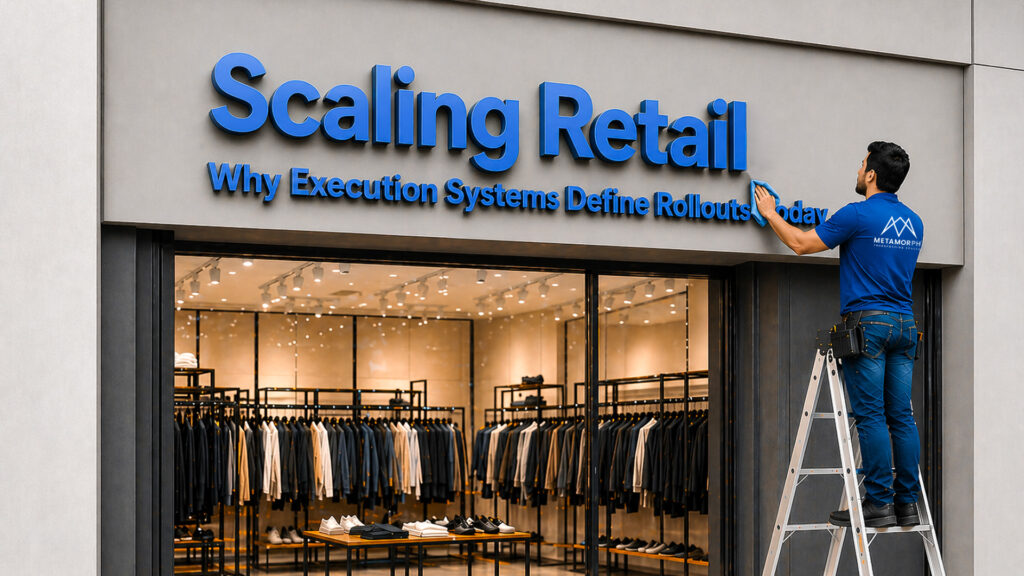
Retail expansion across India is being planned as a network decision. Multiple locations are mapped together, capital is aligned to rollout phases, and timelines are tied directly to store activation. Expansion across malls, high streets, and emerging consumption clusters in Tier 1, Tier 2, and Tier 3 cities is guided by defined growth plans aligned to business outcomes.
This shift is redefining how a Retail Rollout is structured. What was earlier approached as individual store execution now operates as a coordinated program where planning, sequencing, and delivery are aligned across locations.
India’s seven largest cities are expected to add 16.6 million square feet of new shopping mall space by 2026. Retail sector leasing surged to 3.2 million square feet in Q3 2025 alone, marking 65% year-on-year growth across the top seven cities.
Execution At Rollout Scale Creates Repetition
As multiple locations move in parallel, execution begins to repeat outcomes across sites.
A design alignment issue in one drawing carries into production and appears across multiple stores. A delay in material dispatch for one site shifts installation schedules in other cities that are dependent on the same production batch. On-ground teams across fabrication, logistics, and installation begin to face overlapping timelines, creating simultaneous pressure across the rollout.
These disruptions move through the rollout as patterns.
For example, a façade design drawn against standard assumptions rather than verified beam positions enters production unchanged. The first installation requires on-site cutting and adjustment. The same fabrication reaches three more cities. Each site repeats the same modification, increasing installation time, affecting finish quality, and shifting subsequent scheduling.
At this stage, store networks operate through replication. Every input has the potential to multiply across locations.
Retail Signage Carries Visible Impact Across The Network
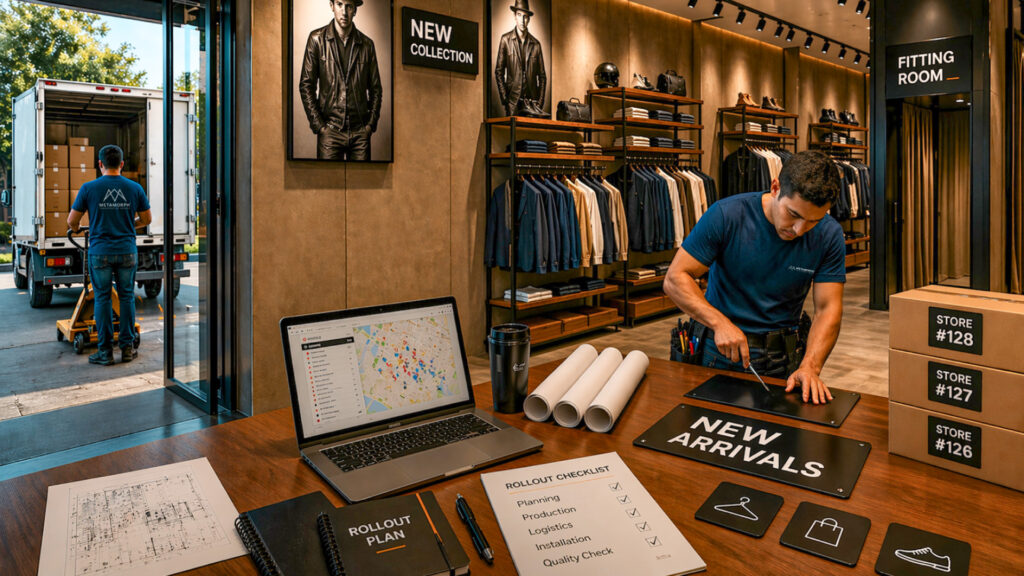
Across a rollout, Retail Signage becomes the most visible expression of consistency, extending into In-Store Branding elements that shape how the brand is experienced within the space.
Execution variables include colour calibration across batches, vinyl and acrylic behaviour under heat exposure, illumination spread across different façade depths, and placement alignment across formats that vary in frontage width and viewing distance. Within the store, the same level of control applies to wayfinding systems, display graphics, and category communication.
These variables translate directly into customer-facing differences.
A colour variation in one production batch may appear marginal in isolation. Across ten stores, it creates a visible shift where the same brand red appears deeper in some locations and slightly faded in others. Illumination inconsistencies across façades produce uneven brightness, while inconsistencies in in-store graphics affect how clearly categories and communication are understood by customers.
These outcomes originate in how materials are standardised, how production is controlled, and how specifications are defined before execution begins. At scale, Store Branding becomes a function of controlled execution, where the same identity is delivered consistently across every location.
For a Retail Branding Agency, signage and in-store environments are aligned to maintain consistency across formats, cities, and conditions.
Execution Systems Connect Decisions Across Stages
Execution systems bring continuity across stages by linking decisions from survey to installation.
Site surveys establish actual conditions, including slab levels, beam positions, and electrical access points. These inputs move into design adaptation, where drawings are adjusted to reflect real constraints. Production then follows these adapted drawings, and installation executes based on the same logic.
The connection between these stages determines how stable execution remains.
Consider a scenario where survey data captures dimensions but misses electrical load distribution for façade signage. Design proceeds with standard assumptions. Production follows the drawing. During installation, wiring adjustments are required to support illumination load. This introduces additional routing, visible surface corrections, and extended installation time.
The same condition appears across multiple locations using the same design set. Each site resolves it independently, increasing variation in execution and affecting overall timelines.
When survey inputs, design adaptation, and production planning are aligned, execution moves forward with site-level corrections resolved before fabrication begins.
A Retail Branding Partner structures this alignment so that decisions made early remain consistent through later stages.
Visibility Maintains Control Across Active Sites
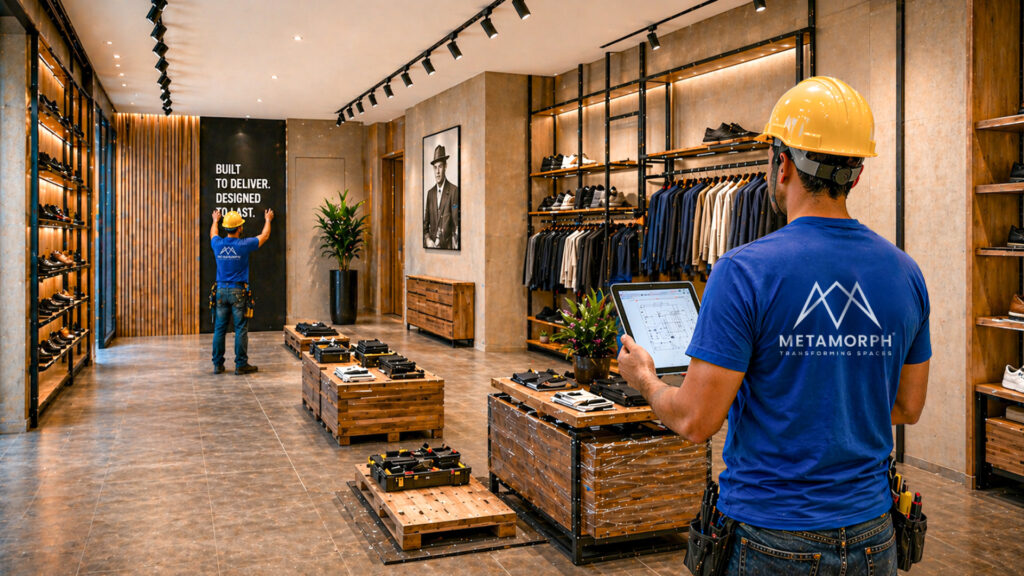
Execution across multiple cities requires continuous visibility into stage-wise progress.
Survey completion, design readiness, production status, dispatch movement, and installation timelines need to be tracked across all active locations. This visibility allows teams to identify shifts in sequence, adjust dependencies, and maintain alignment across the rollout.
For instance, a delay in production for one batch can be identified early and installation schedules in dependent cities can be resequenced accordingly. Material dispatch can be prioritised for sites closer to readiness, reducing idle installation windows. When the same delay is identified late, installation teams arrive at site without material, labour windows are lost, and the delay begins to extend across multiple locations that were aligned to the same sequence.
The Role Of A Retail Branding Partner In Structured Rollouts
As retail expansion scales, execution requires alignment across stages, consistency in output, and control over timelines across cities.
A Retail Branding Partner structures execution so that inputs are standardised before production begins, dependencies are aligned across locations, and site-level variations are resolved at the design stage rather than during installation. This approach ensures that every Retail Rollout delivers consistent output, across every location and format.
Conclusion
Retail expansion is being built as a network, and execution is expected to perform with the same level of consistency across locations.
This consistency is determined by how decisions are structured, how they move through each stage, and how execution is controlled across cities. It defines how effectively Store Branding is carried across formats, locations, and conditions.
When execution relies on coordination, variability surfaces at every stage and compounds across locations. When execution is systemised, the same environment can be delivered repeatedly with controlled output.
That difference defines how retail networks scale.