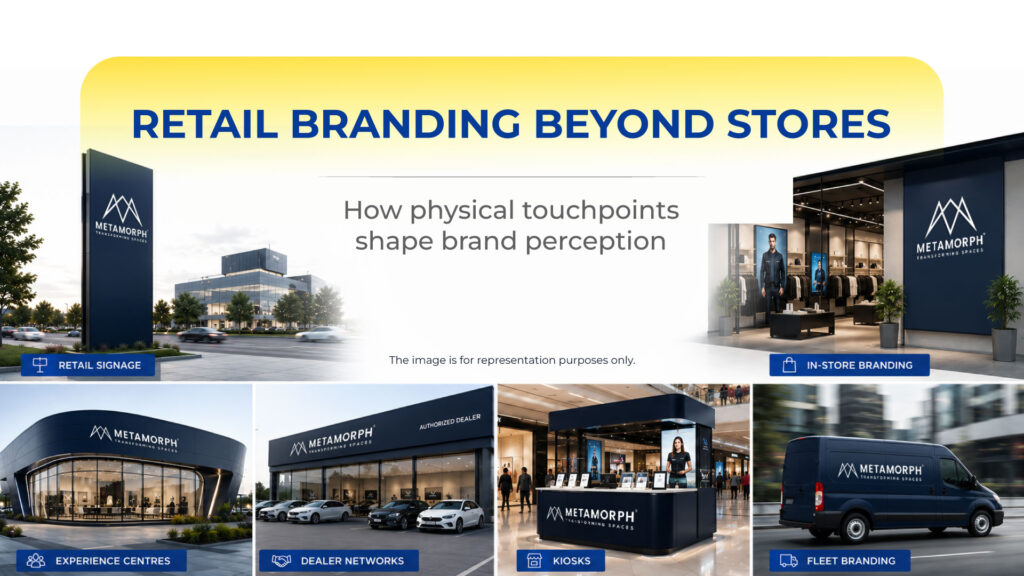
Retail branding still tends to be organised around stores.
Budgets are allocated by format. Teams are divided by channels. Agencies are appointed for specific scopes. Signage sits in one workstream. Experience centres sit in another. Dealer branding often operates independently of both.
From an organisational perspective, this structure makes perfect sense.
From a customer’s perspective, none of these distinctions exist.
A person commuting through the city does not separate a dealer board from a store façade. They do not distinguish between a branded kiosk, an experience centre, or a retail environment. They encounter a brand repeatedly across different places, over different periods of time, and gradually build an impression that feels unified even when the underlying execution is fragmented.
This is one of the more interesting shifts taking place in retail today.
Brands continue to manage physical presence as a collection of individual assets. Customers increasingly experience it as a connected system.
The Customer Never Sees Your Org Chart
Much of retail branding is still planned around moments. The store opening. The experience centre launching. The new signage installation.
These milestones are important because they are visible within the business. Customers experience something entirely different. They encounter brands in fragments.
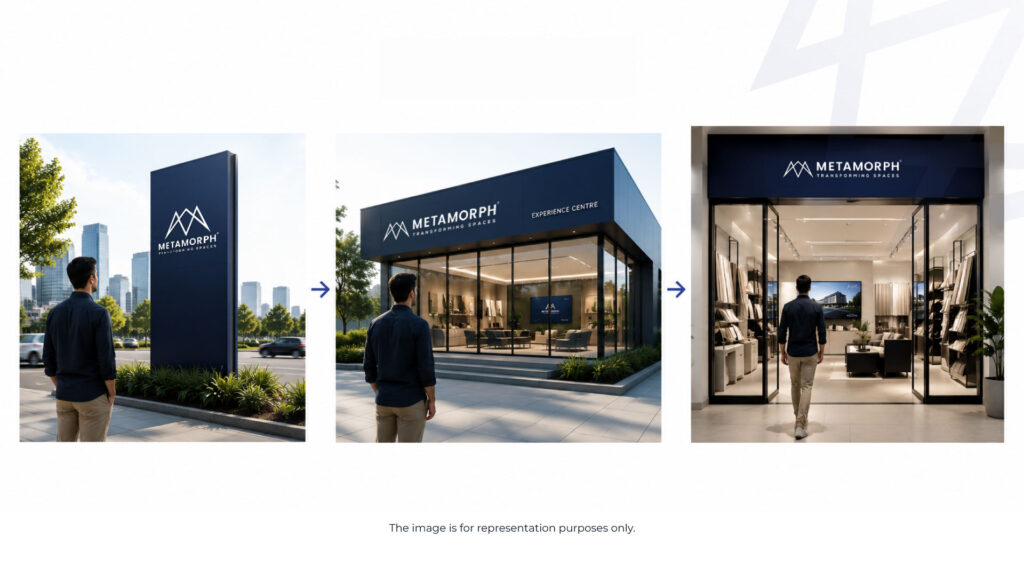
A person might pass the same dealer signage every morning on their way to work for six months without consciously registering it. Weeks later they notice the brand again on the highway pylon. A month after that they walk through an industry exhibition where the brand occupies a large experiential booth. Eventually they enter a store.
This is why some brands appear larger than their actual footprint. Their presence accumulates across environments. Customers feel they know the brand long before a transaction takes place.
Retail Signage Is Closer to Infrastructure Than Advertising
Retail signage is often discussed as a visibility tool. That description understates its role.
Advertising campaigns arrive and disappear. Promotional displays change. Seasonal messaging evolves. Signage remains.
A dealership sign mounted on a busy arterial road may be seen thousands of times before a customer ever engages with the business behind it. A store façade becomes part of a neighbourhood’s visual landscape. Over time, people stop actively noticing it in the same way they stop noticing traffic lights, bus stops, or familiar buildings.
Yet recognition continues to accumulate. This is what makes signage unusual within retail branding. Its influence comes less from persuasion and more from permanence.
Many of the strongest retail brands benefit from years of repeated exposure through physical markers spread across cities and regions. The customer rarely remembers a specific interaction with the signage itself. What remains is a sense of familiarity that feels almost self-generated.
The brand begins to feel established before the customer has any direct experience of it.
Retail Expansion Has Changed What a Brand Looks Like in the Physical World
A decade ago, physical retail presence was relatively easy to map.
A brand operated through stores. Larger organisations added dealerships, distributors, or regional outlets. Most customer journeys followed recognisable patterns.
Today’s retail landscape looks very different.
Experience centres sit alongside traditional stores. Dealer networks serve as brand environments in their own right. Kiosks occupy transit hubs and malls. Temporary activations appear for weeks and disappear. Digital displays introduce dynamic content into physical spaces.
Customers move through this landscape unpredictably.
One customer may spend an hour inside an experience centre before even entering a store. Another may know a brand entirely through dealer environments. Someone else may encounter it only through signage spread across their daily routes.
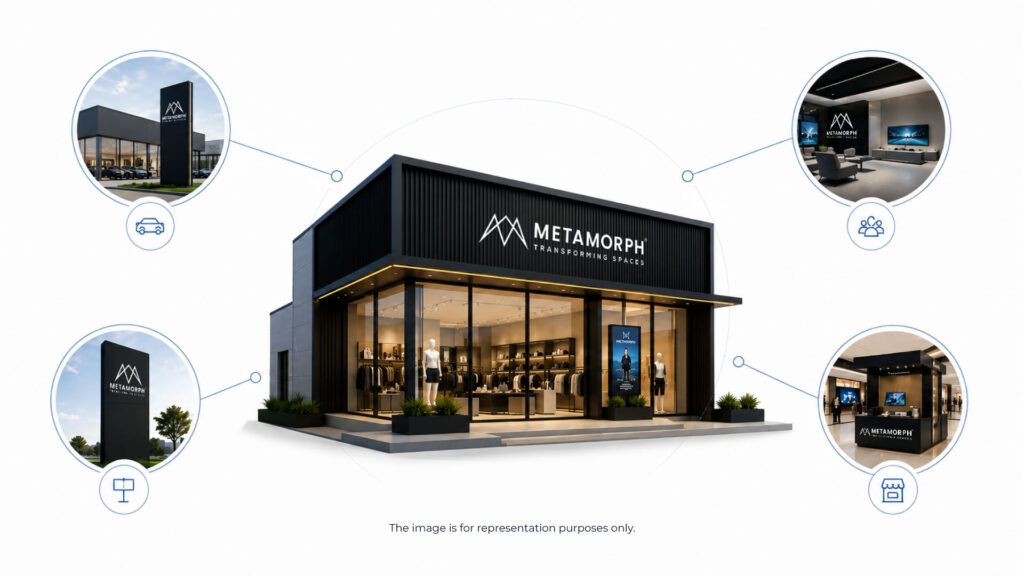
The result is a physical presence that behaves less like a destination and more like a network.
The brand exists simultaneously in multiple places, serving different functions, reaching different audiences, and operating under different conditions.
Consistency Is No Longer a Design Question
Retail conversations often treat consistency as a design challenge.
In practice, the difficulty lies elsewhere.
Most established brands already possess clear guidelines. Colours are defined. Typography is specified. Visual systems are documented in detail.
Yet anyone who spends time visiting physical locations knows that consistency rarely breaks down because somebody used the wrong logo.
A signage system fabricated by one vendor carries a slightly different finish than another. Lighting behaves differently across façades. Material substitutions occur because regional availability varies. Installation conditions influence final output. Dealer environments adapt to local realities. Experience centres receive greater investment than satellite locations.
What they experience is difficult to articulate. Few people stand outside a store and identify inconsistencies in fabrication standards or material execution.
They describe something else. One location feels premium. Another feels functional. One environment feels considered. Another feels temporary.
The language changes, but the underlying reaction remains remarkably consistent.
Customers notice when different parts of the same brand appear to belong to different worlds.
This is where physical branding becomes far more complex than guidelines suggest. The challenge is not preserving identity. The challenge is preserving perception across environments that operate under entirely different constraints.
Brands Are Remembered Through Accumulation
Retail branding discussions often focus on individual touchpoints because individual touchpoints are easier to evaluate.
Stores can be audited. Signage can be inspected. Experience centres can be reviewed. Customers do not experience brands in these isolated categories.
Their perception forms through accumulation.
A retail signage system seen repeatedly over several years. A dealer network encountered during business travel. An experience centre visited once. A store visited twice. A temporary activation remembered from a product launch.
Each encounter contributes something small. Most carry little significance on their own. Together they create a mental picture of what the brand represents.
This helps explain why physical presence remains such a powerful business asset despite the growth of digital channels. Physical environments leave traces. They occupy space within daily life. They become familiar through proximity and repetition.
Customers may forget individual interactions.
They rarely forget how a brand made them feel over time.
Conclusion
Retail branding has expanded far beyond the boundaries of the store.
Customers encounter brands through retail signage, in-store branding, experience centres, dealer networks, kiosks, activations, and countless other physical touchpoints that accumulate across months and years. Each encounter contributes to perception, often in ways that remain invisible to the organisations creating them.
The most significant shift is not the growth of new formats. It is the way customers experience them. Physical presence is increasingly understood as a connected network rather than a collection of individual assets.
As a retail branding partner, Metamorph works within this broader reality. Our role extends across retail signage, in-store branding, experience centres, dealer networks, and rollout programs, helping brands maintain coherence as their physical presence expands across locations and formats.
Because retail branding today is rarely defined by a single store. It is defined by everything customers encounter before, after, and around it.