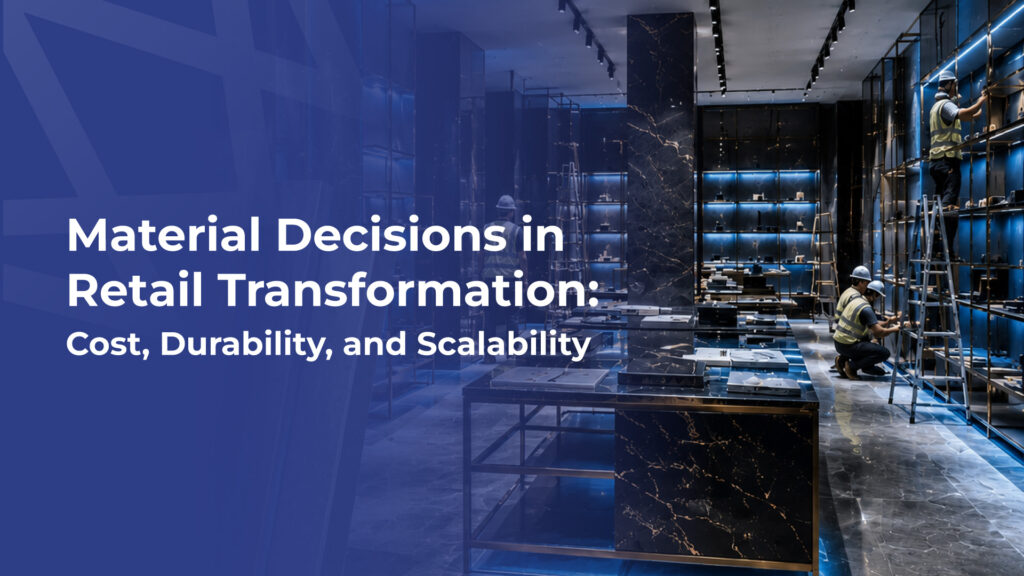
A high-gloss laminate is approved during design review because it delivers the exact depth and reflectivity the brand wants across its display walls, and under controlled lighting the sample reads uniform enough to anchor the entire Store Branding system across locations.
The approval holds because the surface looks right, even as fabrication teams flag that maintaining this finish across volume will require tighter control over batch selection, cutting sequences, and installation conditions.
Fabrication Efficiency and Material Behaviour
Panels from different batches are unpacked and compared under light before cutting begins, and sections that fall outside the acceptable reflection range are set aside, which reduces usable yield and forces reordering within the same production window.
To hold visual continuity across fixtures, fabrication begins to move in sequence rather than parallel, with teams aligning cuts and grain direction across visible panels.
This introduces a different production dynamic:
- Sheets are selected and grouped before cutting instead of being processed in bulk
- Yield drops as visually inconsistent panels are rejected
- Cutting sequences slow down to maintain reflection alignment across runs
- Dispatch timelines begin to tighten against fixed installation schedules
Installation Timelines and On-Site Adjustments
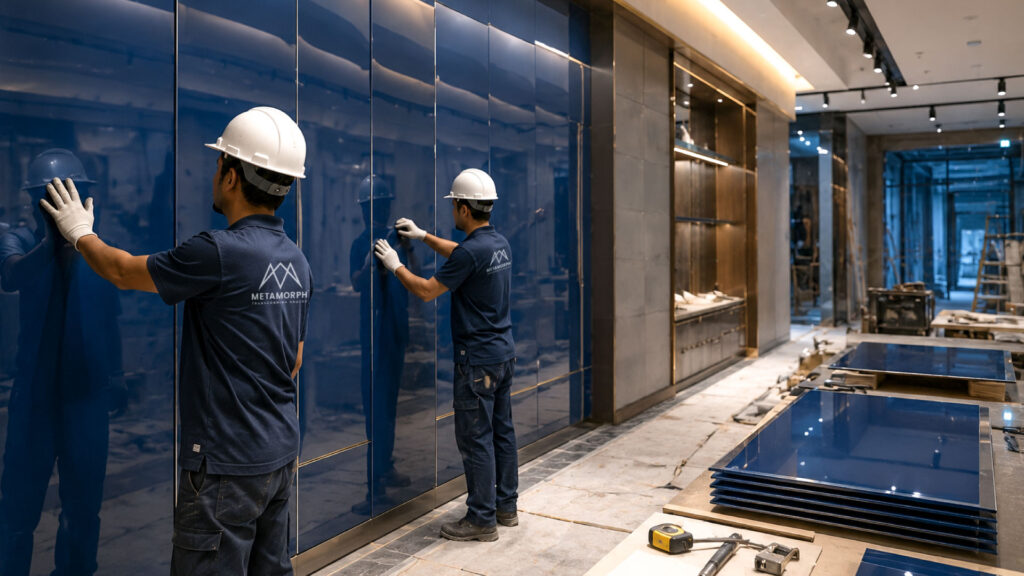
At site, the panels arrive with a limited buffer for correction, and installation begins under lighting conditions that differ from fabrication, making reflection shifts more visible across adjacent surfaces.
The installer flags the variation once the first set of panels is mounted under site lighting, but holding the installation means pulling back already fixed sections and waiting for replacement material within a timeline that is already compressed. The site team proceeds to align panels visually and fix them in sequence, keeping the installation moving while the surface begins to carry slight shifts across adjacent sections.
Durability in In-Store Branding Environments
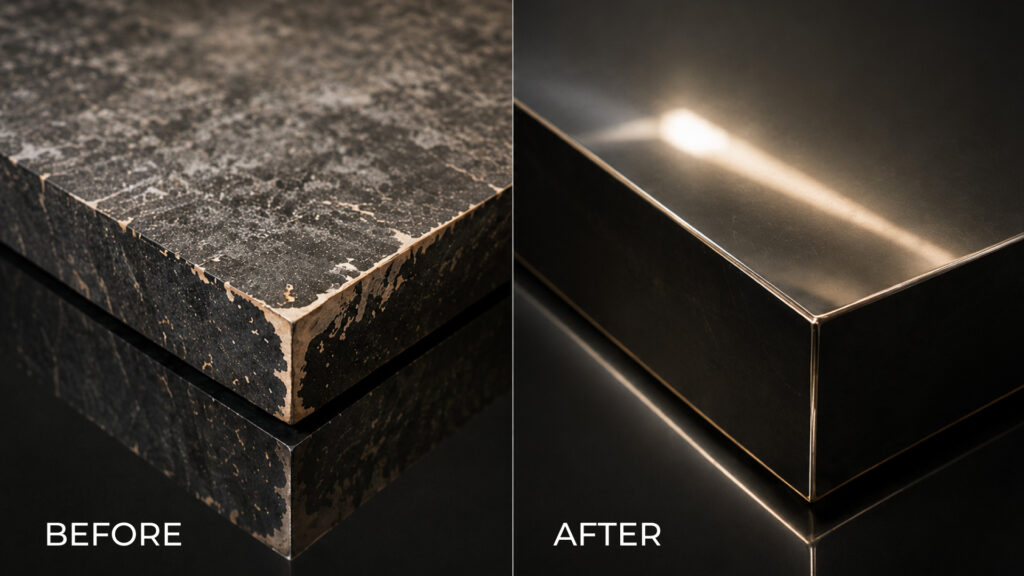
Within weeks of store opening, high-contact zones begin to show fine surface marks where repeated interaction meets the gloss finish, especially along edges and corners where usage is constant.
In some locations, maintenance teams begin polishing out surface marks during routine upkeep, which restores sections temporarily but alters the finish consistency across panels, while in others the surface is left as installed, allowing wear to build gradually along edges and contact zones.
Across locations, maintenance teams respond differently based on available materials and routines, and the surface begins to evolve in uneven ways, with some stores holding the original finish while others show early signs of wear across the same In-Store Branding elements.
Cost Decisions and Their Compounding Effect
Midway through the Retail Rollout, procurement flags rising costs linked to material rejection and reordering cycles, and a decision is taken to introduce a lower-cost alternative that matches the approved sample visually but uses a thinner laminate over a different base.
The revised panels arrive easier to handle and faster to produce, but require additional support during installation to maintain surface stability, adding steps on site that extend alignment time across fixtures already moving through execution.
Scalability Across Retail Rollout Programs
As the rollout expands into additional cities the lead times for the original material continue to shift, and production slots become harder to align across vendors, especially where batch consistency varies across regions.
Earlier stores used to carry one version of the finish, while later locations began to reflect slight differences introduced through alternate materials and adjusted fabrication methods, with all stores operating under the same brand identity.
Material Alignment in Store Branding Systems
In one location, a pre-production review maps how the selected material behaves under actual site lighting and electrical conditions, and the finish is adjusted before fabrication begins, shifting to a controlled matte variant that holds consistency across batches and reduces sensitivity during installation.
At this stage, teams working in a Retail Branding Agency structure, such as Metamorph, intervene by recalibrating material selection against real site inputs rather than sample conditions, updating fabrication drawings to align with how the material will perform once installed.
In locations where this review is skipped, the same surface meets site conditions with minor adjustments at installation, and the finish begins to shift under operational lighting. This is where Metamorph’s involvement in pre-production changes what reaches the site.
Conclusion
Material decisions carry forward into every stage of execution, shaping how fixtures are produced, how they are installed, and how they perform across locations.
The outcome follows the moment a surface was approved because it looked right.